Compliance Toolkit
AML Red Flag Checklist
81 casino-specific AML indicators across 10 risk categories with interactive Excel toolkit for suspicious activity detection and regulatory reporting.
See the Real Impact on Your Department
81 observable indicators across 10 categories — written for the floor, not the textbook.
Give front-line staff something concrete
81 specific, observable red flags replace vague AML theory, so cage, pit and surveillance staff know exactly what to escalate.
Build the documentation trail
The Excel toolkit logs observations, tracks patterns and generates the STR-preparation record DICJ expects.
Close the awareness gap
Turn every shift into an extra set of trained eyes on suspicious activity — before it becomes a regulatory problem.
Affordable across the property
Low cost, high coverage — deployable to teams of any size without a budget fight.
One-time purchase
- Format
- PDF + Excel
- Delivery
- Instant download
12 months of update notifications.
Overview
The AML Red Flag Checklist is a practical, operationally focused resource for casino compliance teams, surveillance staff, and front-line gaming personnel who need to identify and escalate suspicious activity indicators in accordance with Macau's AML/CFT regulatory framework.
This product addresses a critical compliance gap: most AML training discusses suspicious activity in general terms, but front-line staff need specific, observable indicators relevant to their gaming environment. The 81 red flags in this checklist are categorised by operational area (table games, cage, slots, junket operations) and severity level, enabling staff to recognise and escalate potential AML issues before they become regulatory problems.
The included Excel toolkit provides a practical logging and reporting mechanism. Staff can record observations, track patterns, and generate the documentation trail that DICJ expects for suspicious transaction reporting. The checklist aligns directly with Law 2/2006 (Macau's AML/CFT law), DICJ AML directives, and FATF recommendations.
What's Inside
11 sections of structured content.
Category 1
Player Behaviour Indicators (15 flags)
Behavioural red flags: unusual nervousness, avoidance of identification, structuring transactions to avoid thresholds, reluctance to complete CDD, use of nominees, and inconsistent explanation of funds source.
Category 2
Transaction Pattern Indicators (12 flags)
Pattern-based red flags: frequent transactions just below reporting thresholds, rapid chip buy-in and cash-out with minimal play, multiple transactions in rapid succession, and unusual routing of funds through third parties.
Category 3
Chip & Cash Indicators (10 flags)
Chip-related red flags: chip walking between properties, large chip purchases with cash followed by immediate redemption, chip transfers between unrelated players, and unusual chip movement patterns.
Category 4
Junket Operation Indicators (10 flags)
Junket-specific red flags: unexplained source of front money, unusual commission structures, players with no apparent relationship to junket operator, and complex layering through junket credit arrangements.
Category 5
Electronic Gaming Indicators (8 flags)
EGM red flags: unusual jackpot patterns, rapid ticket redemption cycles, suspicious player account activity, and manipulation of player tracking systems.
Category 6
Cage & Count Room Indicators (8 flags)
Cage operation red flags: large cash transactions with suspicious source, third-party payment arrangements, unusual wire transfer patterns, and count room anomaly indicators.
Category 7
Cross-Border Indicators (6 flags)
Cross-border red flags: funds transfers from high-risk jurisdictions, use of foreign exchange services to layer funds, and player profiles inconsistent with stated occupation or income.
Category 8
PEP & Sanctions Indicators (5 flags)
Politically exposed person indicators: reluctance to disclose beneficial ownership, transactions involving sanctioned entities, and connections to high-risk jurisdictions or government officials.
Category 9
Source of Funds Indicators (4 flags)
Source of funds red flags: inability to explain wealth origin, funds from unrelated third parties, and use of complex corporate structures without apparent business purpose.
Category 10
Cyber & Digital Indicators (3 flags)
Digital red flags: use of VPNs to obscure location, multiple accounts from same IP address, and rapid account opening and closing patterns.
Tool
Interactive Excel Toolkit
Practical workbook for logging observations, tracking red flag frequency, generating STR preparation documentation, and maintaining the audit trail DICJ requires for suspicious transaction reporting.
Regulatory alignment
Macau
Law 2/2006
Prevention and suppression of money laundering — suspicious transaction identification obligations
DICJ
AML Directives
DICJ guidance on suspicious transaction reporting and customer due diligence
FATF
Recommendation 20
Suspicious transaction reporting under FATF standards
Macau
Law 16/2022
Enhanced compliance obligations under amended gaming law
DICJ
Circular 01/V/2006
Obligations of gaming operators in preventing money laundering
DICJ
GGRA Guidelines
Gaming-related compliance monitoring requirements
Why teams choose this
- 🎯
81 Specific Indicators
Observable, actionable red flags — not vague general guidance.
- 📊
Excel Toolkit Included
Practical logging and reporting tool for STR documentation.
- 🌏
Macau-Specific
Indicators relevant to Macau gaming operations, not generic financial services AML.
- ⚡
Front-Line Ready
Written for gaming staff, not compliance specialists — immediately understandable.
- ✅
Regulatory Aligned
Directly mapped to DICJ requirements and Law 2/2006 obligations.
- 💰
Cost-Effective
Affordable compliance tool suitable for properties of all sizes.
Built for
Primary audience
- Compliance Officers
- Surveillance Staff
- Cage Cashiers
- Table Game Supervisors
Secondary audience
- AML Analysts
- Risk Managers
- Casino Managers
- Internal Audit Teams
Frequently asked
- Who should use this checklist?
- Designed for front-line gaming staff, surveillance teams, cage personnel, and compliance officers. The indicators are written in operational language that non-specialists can understand and apply.
- How does the Excel toolkit work?
- Staff log observed red flags by category, date, and severity. The tool tracks frequency, auto-flags pattern correlations, and generates summary reports suitable for STR preparation and management reporting.
- Is this sufficient for DICJ compliance?
- This checklist is a critical component of AML compliance but should be integrated into a broader AML programme including CDD procedures, transaction monitoring systems, and staff training.
- Can this be used outside Macau?
- Yes. While tailored for Macau operations, the red flag categories apply across Asia-Pacific gaming markets. Adjust regulatory references for local requirements.
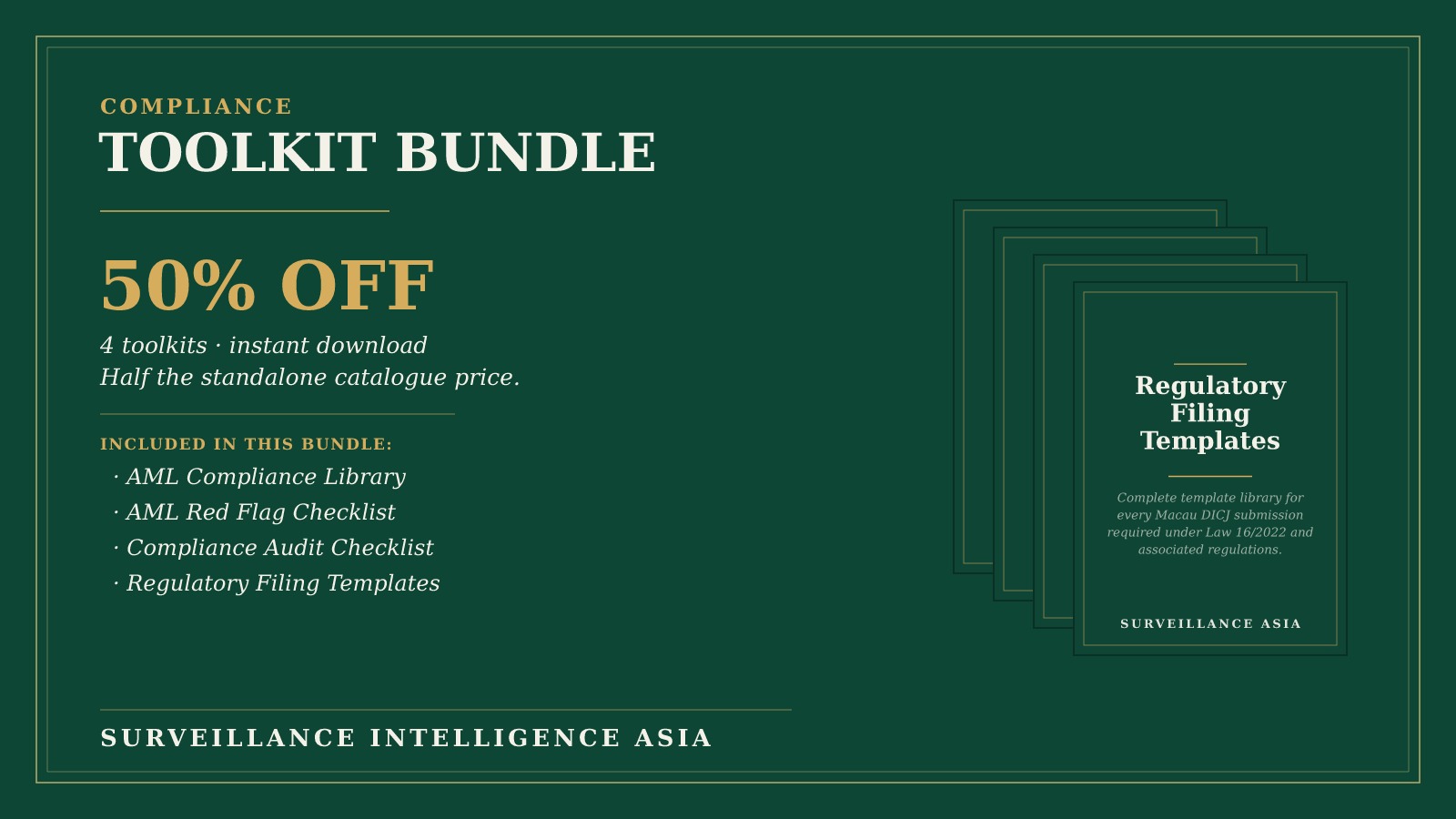
Often paired with
Build out the full compliance stack.
Questions about this product? Email editor@surveillanceasia.com.
One-time purchase
- Format
- PDF + Excel
- Delivery
- Instant download
12 months of update notifications.